Common Challenges in Writing a machinery sourcing specification
Machinery sourcing specifications fail when a supplier can interpret the same sentence in several reasonable ways. Vague capacity targets, missing configurations, undefined interfaces, or acceptance tests with no conditions can produce quotes that look comparable but describe different equipment. Buyers can reduce those gaps by stating measurable requirements, asking suppliers to list deviations, and connecting every critical requirement to evidence and an approval owner.
Key takeaways
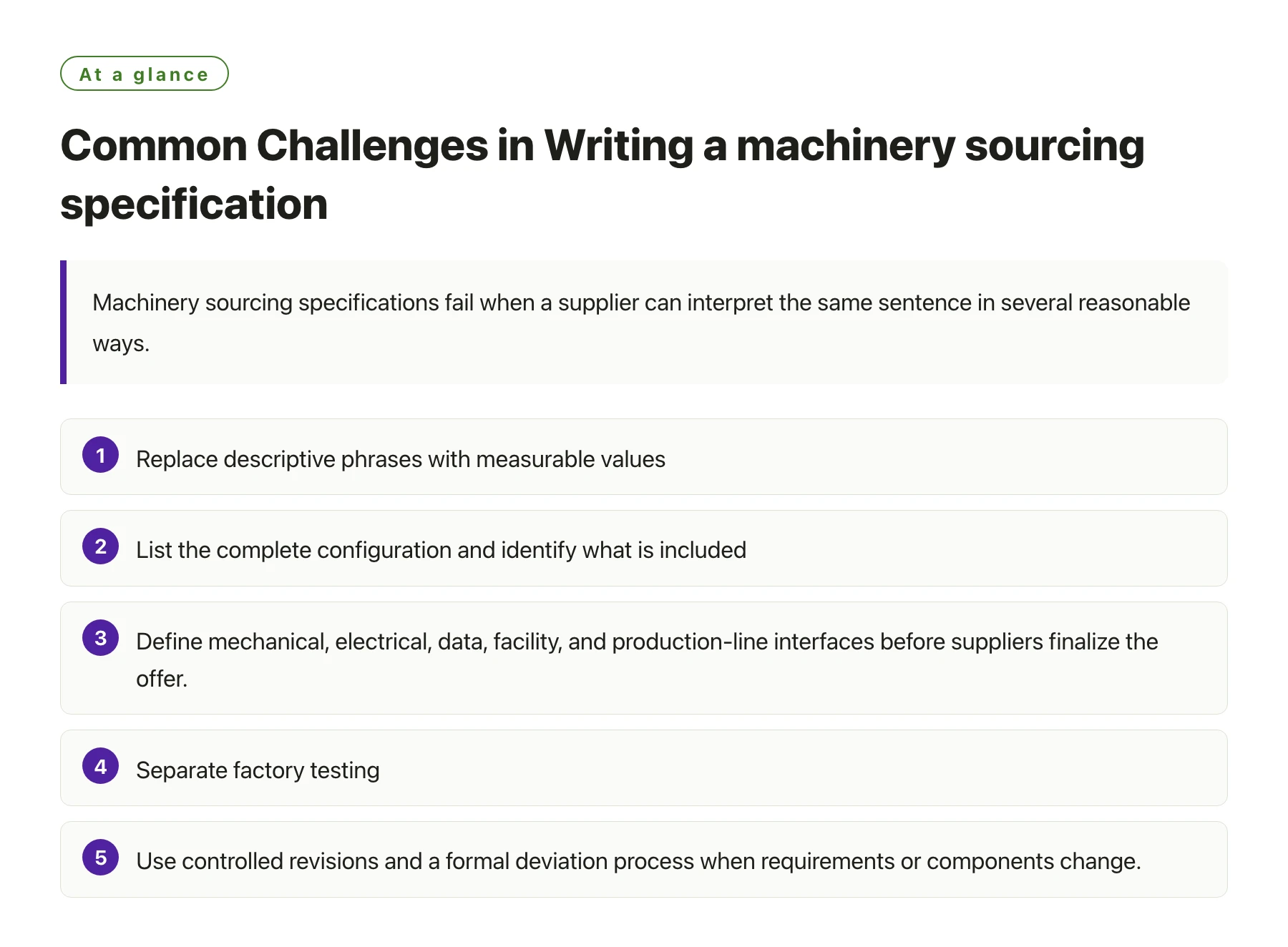
- Replace descriptive phrases with measurable values, operating conditions, and agreed test methods.
- List the complete configuration and identify what is included, optional, buyer-supplied, or excluded.
- Define mechanical, electrical, data, facility, and production-line interfaces before suppliers finalize the offer.
- Separate factory testing, installation checks, site acceptance, and market documentation requirements.
- Use controlled revisions and a formal deviation process when requirements or components change.
- Assign technical, commercial, compliance, and acceptance decisions to named reviewers.
A machinery requirement can be clear to the engineer who wrote it and still be incomplete for a supplier quoting a build. Different teams may use a term like heavy-duty, automatic, or production-ready to mean different things. The specification should define the evidence that will settle each important question, not rely on confidence, brand reputation, or a certificate unrelated to the ordered configuration.
Challenge: performance words have no test condition
Words such as fast, accurate, robust, high-capacity, and industrial-grade leave room for interpretation. Replace them with a value, range, tolerance, or observable outcome and state the material, input condition, tool, setup, operator, operating mode, and measurement method that applies. A throughput target without those conditions may describe different workloads across suppliers.
Identify which performance values are design goals and which are acceptance limits. The supplier should not be expected to infer that a desired target is a guaranteed contractual result. If a value cannot be finalized before quotation, mark it as open and state what information is needed, who will decide, and the date it must be settled.
Ask the supplier to explain any assumptions used to meet a target. If the quote depends on a specific material, duty cycle, input quality, or operator skill, record that basis beside the performance claim so the buyer can judge whether it matches the intended operation.
Challenge: the machine name hides options and exclusions
A model family may have different motors, controls, tooling, guards, software, fixtures, accessories, and optional modules. List the exact configuration and ask suppliers to return model codes and an included-items schedule. Identify what is supplied by the buyer, what is priced separately, what is installed by another contractor, and what is not offered.
Require an exception list for every deviation. A supplier may propose a different component or operating range that is acceptable, but the effect on output, compatibility, maintenance, safety, warranty, and schedule needs review. If an option is accepted, add it to the controlled purchase configuration rather than leaving the decision in an email thread.
Check that drawings, quotations, test documents, and purchase orders use identifiers that refer to the same revision. If two vendors quote against different assumptions or option packages, normalize them before comparing prices.
Challenge: interface details are assigned to nobody
Machinery must connect to a real site and sometimes to an existing production line. State footprint, access clearances, foundation or anchoring, infeed and outfeed dimensions, utilities, extraction, drainage, network connections, controls, guards, and required service access as applicable. Attach drawings and identify which party verifies each connection with the building, equipment, or controls contractor.
Name the owner for compatibility review. A supplier may define its machine boundary while a buyer's team defines the building or line boundary; the specification needs a shared interface drawing or responsibility schedule. If the supplier's layout changes, require a revision and recheck affected connections before fabrication or installation.
Ask how installation sequence and access affect the design. A machine can meet its footprint yet be impossible to move through a doorway or service after the line is built. Identify transport dimensions, lifting points, panel removal, and maintenance clearance when they affect the project.
Challenge: acceptance tests are defined after production
A specification should state how critical requirements will be demonstrated before the buyer signs off. Define factory test conditions, material, tooling, warm-up or setup, sample quantity, measurement equipment, acceptable result, and records. A brief no-load run cannot establish performance under the buyer's intended production conditions, and a visual check cannot establish accuracy.
Separate factory acceptance from site installation and operational acceptance. State which tests happen at each location, who supplies test material and utilities, which personnel attend, and how a failed result is corrected and retested. If a site test depends on upstream equipment or utilities, identify those dependencies so the supplier is not held to a condition the buyer has not provided.
A quality-management certificate is not a substitute for product acceptance criteria. ISO explains that ISO 9001 specifies requirements for an organization's quality management system; it does not dictate one universal operating method.[1] Buyers still need requirements and evidence that address the particular machine, site, configuration, and intended use.
Challenge: compliance documents are treated as one generic checklist
Identify the destination market and product category, then ask a qualified reviewer which safety, electrical, environmental, labeling, and import documents apply. Requirements can differ by market and machine type. Request the supplier's available evidence and confirm that it names the exact model, configuration, manufacturer, and responsible party relevant to the purchase.
Do not accept a generic company certificate as evidence that a specific machine satisfies every product rule. Check scope, issuing party, site, date, and standards or regulations covered. If the supplier proposes a document that is not clearly matched to the equipment, ask the issuer or qualified reviewer to clarify its applicability before the purchase depends on it.
Assign who will prepare, review, translate, and retain each required document. Set due dates that fit testing and shipment milestones so missing information is discovered before the equipment is packed or delivered.
Challenge: revision changes are handled informally
Specifications evolve as engineering, suppliers, and project teams learn more. Use a revision number, issue date, change summary, and approval status. Tell suppliers which version is current and ask them to acknowledge updates. Withdraw outdated copies or mark them superseded so production teams do not build against a previous drawing.
Create a deviation process for supplier proposals and buyer changes. Each request should identify affected components, performance, safety or compliance implications, cost, schedule, documents, and required approval. State whether the change applies to one unit, a batch, or all future production. Keep the decision record with the purchase order and test plan.
Before production release, reconcile the accepted quotation, drawings, component list, software version, test plan, and documentation schedule. That short check can catch disagreements that would otherwise appear during inspection or commissioning.
Use a supplier response matrix to close open points
A response matrix lets each supplier mark a requirement as met, alternative, excluded, or needing clarification and cite supporting evidence. Include an owner and due date for unresolved items. Review it with engineering, procurement, quality, and compliance before selecting a supplier so no one assumes another team approved a gap.
Once the specification is aligned, the team can compare price and schedule on a common basis. For coordination with a China-based sourcing partner, review Shanghai JS Sourcing alongside the buyer's assigned technical review, contract authority, and acceptance responsibilities. A clear service scope supports communication, while the specification remains the record of what equipment is being purchased.
Sources
Frequently asked questions
What is the most important part of a machinery sourcing specification?
The requirements that determine whether the machine fits the process and how those requirements will be verified. State configuration, operating conditions, interfaces, acceptance tests, documents, and owners for unresolved decisions.
Can a supplier choose a test method if the buyer has not specified one?
The supplier can propose a method, but the buyer should review whether it measures the intended requirement under agreed conditions. Record the accepted method and limits before production or acceptance testing.
Does an ISO 9001 certificate prove that a machine meets a specification?
No. It concerns an organization's quality management system within its scope. Product acceptance needs evidence tied to the ordered machine, configuration, and test criteria.
When should a machinery specification be revised?
Revise it whenever an approved requirement, configuration, interface, test, or document changes. Record the affected items, revision, approval owner, and supplier acknowledgment.